About Na Hanauna (Generations): Stories of Yesterday, Today, and Tomorrow
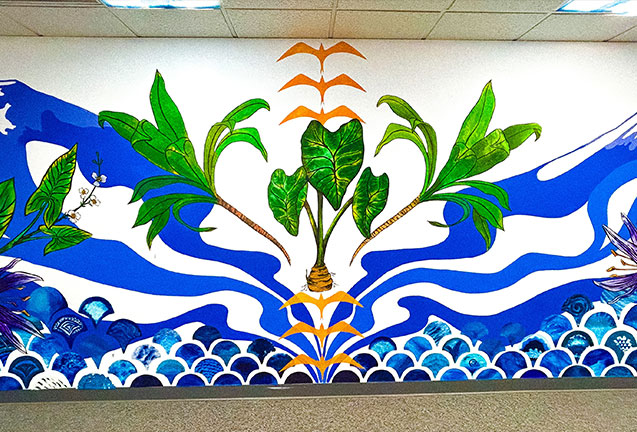
For more than three centuries,
Native Hawaiians have cultivated enduring relationships with the Indigenous
lands and peoples of Turtle Island. Today, Native Hawaiians and Native American
communities continue to assert visibility, kinship, and kuleana (stewardship) to the lands now governed as
the United States of America. "As Pacific Islanders, our connection to the
ocean (kai) travels with us, shaping our identities, responsibilities,
and ways of being no matter where we reside." - Leialoha Ka'ula, KALO executive
director.
This panel discussion in partnership
with KALO brings together Native Hawaiians who, though displaced from Hawaii,
now call Oregon home. Across generations, this lahui (community) has
rooted itself in the Pacific Northwest, sustaining culture, community, and 'ike
(knowing) despite limited access to Hawaiian cultural resources. Through this
gathering, KALO members will talk
story, honor the voices of kupuna (ancestors),
reflect on lived realities of the present, and envision pathways forward for
future generations. Join us for a discussion to make meaning and create new
narratives of belonging, resilience, and continuity.
Leialoha Ka'ula
is a Native Hawaiian community leader, cultural practitioner, and organizer
based in the Pacific Northwest. She is an active member of Ka 'Aha Lahui O
'Olekona (KALO), where her work centers on 'ike kupuna, cultural continuity,
and building pathways for Native Hawaiian families living away from Hawaii.
Rooted in values of kuleana, pilina, and malama 'aina, Leialoha
is deeply committed to intergenerational education and community-based cultural
programming. She has played a key role in developing initiatives that uplift 'ike
Hawaii, support youth leadership, and strengthen relationships between Native
Hawaiian and Indigenous communities of Turtle Island. Her work often bridges
past, present, and future, honoring ancestral knowledge while creating space
for new stories and leadership to emerge. Through program development,
storytelling, and strategic planning, Leialoha works to ensure that Native
Hawaiians in the diaspora remain connected to culture, community, and one
another, fostering resilience and belonging across generations.
Louise Wilmes
is a Native Hawaiian and a proud member of the Otoe-Missouria Indian Tribe,
born and raised on O'ahu and a graduate of Kamehameha Schools. For more than
forty years, she carried the spirit of aloha into Oregon classrooms, dedicating
her career to nurturing young learners and advocating for Indigenous students
and families. Louise served the Beaverton School District as an elementary
educator teaching grades K-6 and later as the Title VI Indian Education
Coordinator, where she worked tirelessly to uplift Native students, strengthen
cultural identity, and advance educational equity. Her leadership and advocacy
created lasting impacts for Indigenous communities within the school system.
After retiring from public education, Wilmes continues her lifelong commitment
to culture and community. In 2019, she joined Ka 'Aha Lahui O 'Olekona (KALO),
remaining deeply connected to her Native Hawaiian heritage while fostering
intergenerational relationships in the Pacific Northwest. She holds degrees
from Pacific University and George Fox University, and remains a respected
educator, mentor, and cultural bearer whose life's work reflects service, aloha,
and kuleana.
Toni Iwalani Fujiwara
is a first-generation Native Hawaiian born on Moku Honu, with ancestral roots
in He'eia, O'ahu, and multigenerational ties to Southeast Portland. She was
born in Charlotte, North Carolina and later raised in Oregon, where she attended
Sandy High School after her family relocated to Sandy. Growing up on Indigenous
lands once stewarded by the Clackamas people, near Wy'east and the Sandy River,
deeply shaped her understanding of place and responsibility. She was raised
largely disconnected from her Native Hawaiian culture, language, and 'ohana,
Fujiwara carried a lifelong sense of longing that later informed her commitment
to community, belonging, and cultural reconnection. She spent nearly two
decades working in education, supporting youth and communities of higher
promise, with a focus on empowering Pacific Islander and Indigenous students
through relationship-centered and youth-led approaches. In January 2025,
Fujiwara was introduced to Ka 'Aha Lahui O 'Olekona (KALO), where she began reconnecting
with her culture through Papa 'Olelo Hawaii, foundational cultural practices,
and working in the mala tending kalo and caring for kupuna.
As she enters this new chapter, Fujiwara is committed to deepening her
relationship with 'aina and lahui, leading with aloha, and
sharing 'ike with others seeking healing, connection, and a sense of
belonging.
Nohea'ililani Waiwai'ole (she/they/'oia)
is the hiapo of the third generation of her 'ohana born into the
Hawaiian diaspora and settled along the west coast of Moku Honu. She is mixed
Kanaka Maoli and white; her paternal great-grandfather was born and raised in
Pearl City and was displaced from Hawaii during World War II. Raised primarily
in rural Oregon, with parts of her childhood spent in Hilo, Waiwai'ole has,
since 2019, lived on the occupied lands of the Multnomah, Chinook, Clackamas,
Cowlitz, and Kalapuya peoples in what is now known as Portland, Oregon. Most
important to Waiwai'ole is spending time with her daughter and 'ohana,
engaging in cultural reclamation through practices such as hula and 'olelo
Hawaii, and organizing and strategizing toward collective liberation and
Kanaka sovereignty.
